

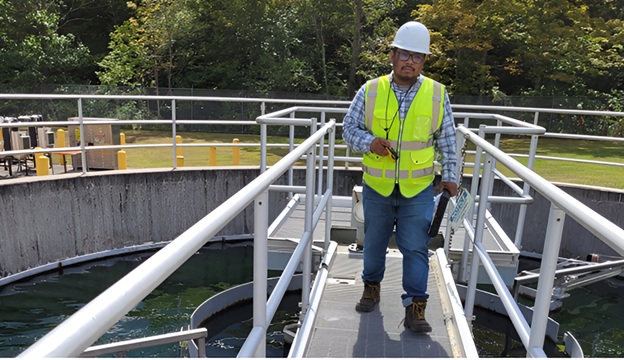
Q1. Please introduce yourself and describe your professional background.
My name is Santunu Barua, and I am an Environmental Engineer specializing in industrial stormwater management, PFAS remediation technologies, and smart environmental compliance systems. I currently work in the United States in environmental engineering and regulatory compliance, supporting industrial facilities with stormwater permitting, discharge monitoring, environmental reporting, and infrastructure planning.
My academic background includes a Master of Science in Environmental Engineering from Manhattan University, along with professional experience in environmental infrastructure, stormwater management, and water quality systems across both the United States and Bangladesh. My work combines engineering practice, applied environmental research, and technology-driven compliance solutions.


My research profile and publications are available through my Google Scholar profile:
(https://scholar.google.com/citations?user=3cqjLScAAAAJ&hl=en)
Q2. What is the primary focus of your proposed endeavor in the United States?
My proposed endeavor focuses on developing, validating, and deploying reactive adsorption-based treatment systems for PFAS removal from industrial stormwater discharges in the United States.
This work is particularly important because the U.S. Environmental Protection Agency’s proposed 2026 Multi-Sector General Permit (MSGP) would introduce PFAS monitoring requirements across a broad range of industrial sectors. Many facilities currently lack practical and scalable treatment technologies specifically designed for PFAS-contaminated stormwater runoff.
My endeavor addresses this regulatory and environmental gap through three integrated components:
- Field validation of reactive soil mix and biochar-enhanced filtration systems for PFAS capture;
- Development of IoT-enabled real-time monitoring and compliance platforms; and
- National dissemination of scalable engineering guidance for industrial stormwater treatment applications.
The objective is to create retrofit-ready, cost-effective, and scientifically validated systems that help industries comply with evolving federal environmental regulations while reducing PFAS contamination risks to U.S. water resources.
Q3. Why is PFAS contamination in industrial stormwater an important national issue?
PFAS contamination has become one of the most significant emerging environmental challenges in the United States. These compounds are often called “forever chemicals” because they persist in the environment and can accumulate in water systems over time.
Industrial stormwater represents an increasingly important pathway through which PFAS can enter rivers, groundwater systems, and public water supplies. However, many existing stormwater control systems were not originally designed to capture or treat PFAS compounds.
The proposed federal MSGP framework signals a major shift toward nationwide PFAS oversight in industrial stormwater regulation. As industries prepare for stricter monitoring and compliance obligations, there is a growing need for scalable engineering solutions that can be integrated into existing stormwater infrastructure without requiring complete system replacement.
My work seeks to address this need through practical treatment technologies and digital compliance tools that can support both environmental protection and regulatory implementation nationwide.
Q4. How does your research contribute to this field?
My research focuses on integrating adsorption science, stormwater engineering, and digital environmental monitoring technologies.
One of my major research contributions involves reactive soil mixes and biochar-enhanced filtration media for PFAS adsorption within stormwater infiltration systems. My studies investigate how engineered media can improve contaminant capture while remaining compatible with existing industrial stormwater infrastructure.
I have also conducted research on IoT-enabled stormwater monitoring systems, AI-driven predictive compliance models, and real-time environmental data integration for industrial facilities.
Several of my publications focus directly on PFAS treatment, industrial stormwater management, and emerging environmental technologies. My research has received growing academic attention and citations internationally.
My Google Scholar profile documents my publications, citations, and ongoing research contributions:
(https://scholar.google.com/citations?user=3cqjLScAAAAJ&hl=en)
Q5. Can you describe the technological innovation behind your proposed systems?
The innovation lies in combining engineered adsorption materials with intelligent compliance infrastructure.
The treatment systems are designed to use reactive media — including modified soil blends and biochar-enhanced filtration systems — capable of adsorbing PFAS compounds from industrial runoff before discharge.
In parallel, the monitoring platform integrates:
- IoT-enabled water quality sensing,
- automated exceedance tracking,
- compliance threshold monitoring,
- automated reporting support, and
- digital decision-support tools for industrial operators.
This integrated approach moves industrial stormwater management from a largely reactive process toward a more predictive, data-driven, and technology-enabled compliance framework.
Q6. How does your endeavor benefit the United States?
My endeavor supports several important U.S. national interests:
- Protection of water quality and public health;
- Advancement of environmental engineering innovation;
- Support for federal and state regulatory implementation;
- Strengthening industrial environmental compliance capacity;
- Climate resilience and sustainable infrastructure modernization; and
- Development of scalable environmental technologies that can be deployed nationally.
Because the proposed systems are designed for retrofit applications, they may help reduce the cost burden associated with future PFAS compliance obligations for industrial facilities.
Additionally, the work contributes to scientific research, engineering education, and technology dissemination within the environmental sector.
Q7. What makes you well-positioned to advance this endeavor?
My background combines environmental engineering practice, stormwater regulatory experience, applied research, and technology development.
Professionally, I have worked on stormwater permitting, SPDES/MSGP compliance, discharge monitoring reporting, environmental site assessments, and industrial infrastructure projects in the United States.
Academically, my research portfolio includes publications related to PFAS remediation, stormwater treatment systems, adsorption technologies, AI-driven compliance systems, and sustainable environmental engineering.
I have also participated in research collaborations, technical reviews, editorial activities, and professional engineering organizations related to environmental management and water quality systems.
This combination of engineering implementation experience and ongoing research activity allows me to bridge the gap between academic innovation and real-world regulatory application.
Q8. What are your long-term goals for this work?
My long-term goal is to help establish scalable and scientifically validated stormwater treatment strategies that can support the next generation of industrial water quality management in the United States.
I intend to continue advancing PFAS treatment technologies, smart stormwater infrastructure systems, and AI-supported compliance platforms while contributing to national discussions on environmental resilience and sustainable infrastructure modernization.
I also aim to expand collaboration with academic institutions, industry stakeholders, and regulatory professionals to promote broader adoption of innovative stormwater treatment solutions across multiple industrial sectors.
Closing Statement
Santunu Barua’s work represents an emerging intersection of environmental engineering, digital compliance technology, and industrial stormwater innovation. Through applied PFAS remediation research, smart monitoring systems, and scalable infrastructure strategies, his proposed endeavor seeks to support the evolving environmental and regulatory needs of the United States while contributing to long-term public health and water resource protection.