
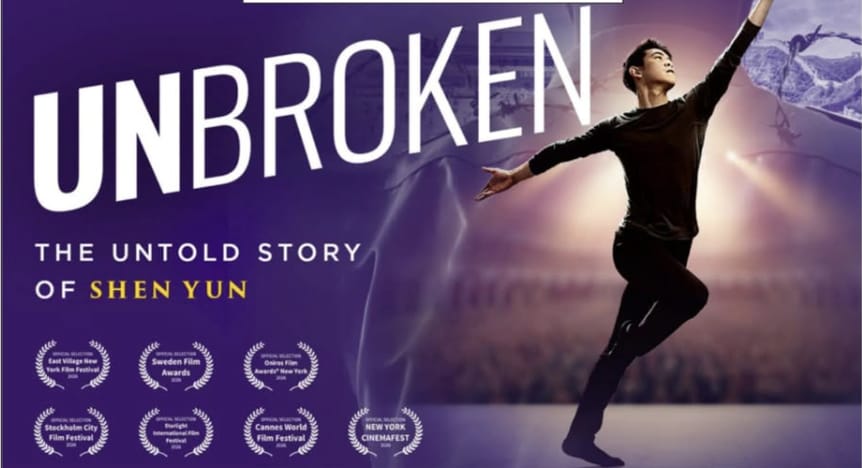
Ahead of a special Capitol Hill screening of the award-winning documentary UNBROKEN: The Untold Story of Shen Yun, Washington Week speaks with Steve Lance, Executive Producer of Sincere Pictures and Investigative Journalist with NTD Television, about the making of the film, the investigation behind the story, and the personal experiences of the performers featured in the documentary.
The special Capitol Hill screening takes place on July 22, 2026, in Washington, D.C. The evening will feature remarks from members of Congress, a screening of UNBROKEN, and a live panel discussion with the filmmakers and Shen Yun artists exploring their firsthand experiences with artistic freedom and transnational repression. The event will begin with a reception at 6:00 PM, followed by the program at 7:00 PM.
RELATED STORIES


In this interview, Lance discusses what first drew him to the story of Shen Yun Performing Arts, the challenges of documenting alleged interference and intimidation campaigns, and how the film examines the intersection of art, faith, cultural preservation, and freedom of expression.
Through the journeys of performers who dedicated years to mastering classical Chinese dance, UNBROKEN explores a story that extends beyond the stage, highlighting questions surrounding artistic freedom, cultural heritage, and the impact of political pressure on creative expression.
What first drew you to the story of Shen Yun Performing Arts, and what made you feel this was a story that needed to be told through a documentary?
My path to this story actually began more than twenty years ago. Early in my career, I did investigative reporting on Chinese Student and Scholar Associations on American university campuses, which are organizations that often functioned as informal extensions of the Chinese Communist Party’s United Front work. That experience taught me how the Party shapes narratives and influences institutions far outside China’s borders.
So when I noticed an unusually intense amount of negative editorial attention being directed at Shen Yun, it got my attention. I had covered Shen Yun before, and the allegations did not match what I had seen firsthand. Having observed respected professors and prestigious universities here in the U.S. carry Beijing’s narratives in the past, it was not a stretch for me to ask whether other American institutions could be vulnerable to the same kind of influence.
But I want to be clear: I started with questions, not a conclusion. What turned this from a news segment into a documentary was the scale of what we found. Roughly 140 documented incidents of interference, from bomb threats to slashed tires to coordinated bot campaigns, was a story so large, and with so much evidence, that I realized it needed to be shown, not just told.
UNBROKEN follows the journey of performers who go from ordinary American childhoods to international stages. How did you approach capturing both the personal stories of the performers and the larger cultural significance of their work?
The film really lives on two tracks. One track follows the performers, most centrally two brothers, Jesse and Lucas Browde, who grew up playing baseball in New York like many American kids but who went on to become world-class classical Chinese dancers touring the globe. It is somewhat a young man’s coming-of-age story. The other track follows the investigation that I led along with my research team.
Our director, Fiona Young, understood that the personal stories had to lead. Audiences do not connect with geopolitics first. They connect with a father watching his sons graduate, or a young dancer describing why she performs. Once you know these people, the larger story really hits home because the threats are no longer abstract and are aimed at families you have come to care about.
The cultural significance flows naturally from there. These young artists are reviving an art form and a heritage that was nearly destroyed after 1949. Many of them, like dancer Steve Wang, have direct family connections to the persecution in China. His father was persecuted to death for practicing Falun Gong. When you understand that part of the story, you understand that what happens on that stage every night is not just entertainment. It is part of a much larger context that informs the geopolitical narrative as well.
The film explores the intersection of art, faith, and freedom. What did you discover about the role creative expression can play when it comes into conflict with political pressure or censorship?
What I discovered is that art can say things that reports and press releases cannot. And that is exactly why Beijing considers a dance company a threat. Shen Yun presents China’s five thousand years of civilization, including its spiritual traditions, as something living and beautiful. That directly contradicts the Party’s claim to define what Chinese culture is. And Shen Yun does it beyond the reach of Chinese censors, in front of millions of people across two hundred cities a year.
I also came to appreciate how faith sustains these artists under pressure that would break most organizations. There is a moment in the film where the performers describe bomb-sniffing dogs sweeping the theater before curtain. That has become their “normal.” And yet Lucas Browde says they almost could not wait to go on tour. His brother Jesse says they are giving a voice to people who cannot speak out.
That is what I found at this intersection of art, faith, and freedom. Censorship works through fear. But when artists believe their work serves something higher than themselves, fear loses its leverage. We witnessed that at each step of the filming process. It wasn’t a political statement, it was the artists’ truth and we were able to capture that on camera, which I found quite inspiring.
What were some of the biggest challenges you faced while making UNBROKEN, whether from a filmmaking perspective or in gaining access to the personal stories behind the performers?
The investigative side had a challenge familiar to any journalist covering foreign influence: this is an adversary that works hard not to leave fingerprints. Threats arrive through proxies. Pressure campaigns are laundered through lawsuits, protests, and social media accounts. Our job was to build an evidence chain that could hold the weight of this story. I had to call the doctors the media did not call, read the medical records, trace the digital activity, identify the sources, and connect the dots. When Taiwanese authorities traced bomb threats against the Taiwan tour to an area around a Huawei research center in mainland China, that was the kind of hard evidence we were working toward, so that we had documentation, not accusation. That takes time but it is essential.
On the personal side, the other challenge was trust. These are people who have received death threats, some targeting their children. Asking them to relive that on camera is asking a great deal. There is a scene where Leeshai Lemish, a Shen Yun emcee and a father of two young daughters, reads aloud a threat describing violence against children. He struggles through it. Moments like that only happen when people trust that you will handle their story with care. We tried to earn that trust and never take it lightly.
The documentary examines allegations of intimidation and interference connected to the Chinese Communist Party. How did you balance investigative reporting with the deeply personal experiences of the people featured in the film?
We had to keep clear throughout the process that the evidence must carry any argument in the story, and the people can carry the heart of it. We never asked the personal stories to do the work of proof, and we never let the documents crowd out the human beings. It sounds easier writing about it after the film is finished, but like any documentary, it is a process.
On the investigative track, everything is sourced and shown on screen, such as court filings, medical records, threat transcripts, screenshots of bot accounts that the platform X later removed by the thousands, an FBI sting that caught two agents attempting to bribe an IRS official to revoke Shen Yun’s nonprofit status. We put the evidence in front of the audience and let them draw their own conclusions.
The personal experiences then show what that evidence means in human life. For example, what it is like to put your children on a tour bus after tires have been slashed in a way designed to blow out at highway speed.
Keeping those two threads distinct, and letting each do its own job, was how we kept the film honest. I should add: we were careful not to frame any American institution as the villain of this story. The architect of this campaign sits in Beijing. That distinction was clear to me in the evidence, and so that is what we presented.
The performers in UNBROKEN dedicate years to mastering classical Chinese dance. What surprised you most about their training, discipline, and commitment to their craft?
I played competitive hockey growing up, so I thought I understood athletic discipline. These young artists operate at a level that genuinely surprised me. Classical Chinese dance demands the explosiveness of an elite gymnast, the precision of a ballet dancer, and the stamina to perform across a tour of roughly two hundred cities. They manage their bodies like professional athletes, and then go on stage and make it all look effortless.
But beyond the discipline, the motivation is what impacted me more. Angela Lin, one of the dancers, describes herself as an introvert, and genuinely is in person, and yet she performs before thousands of people, night after night, because the art gave her a voice she feels comfortable to use. Steve Wang dances to honor his father, who died under persecution in China. When your craft is connected to something that deep, discipline stops being a burden. It becomes mastery and a pursuit of excellence. That is something I think anyone in high-level sports or performance will recognize immediately, and it is one reason the film is resonating with such a broad audience.
After audiences watch UNBROKEN, what conversations or questions do you hope the film inspires about artistic freedom, cultural preservation, and standing up to intimidation?
The first conversation I hope for is that they tell people to see it for themselves and define their own meaning and experience. Diversity of thought means being willing to look past prevailing narratives and examine the evidence for oneself.
The second conversation is bigger than Shen Yun. The methods documented in this film, such as the lawfare, the media pressure, the intimidation through proxies, are a blueprint. If a foreign government can run this playbook against a dance company on American soil, it can run it against a university, a business, a newsroom, or a church. The question I hope viewers ask is not just “what happened to Shen Yun?” but “what does this mean for our own institutions?”
And finally, I hope people walk away with the question the performers themselves answered. When intimidation arrived, they did not retreat. They kept performing. What would each of us do in their place? I think their answer is giving audiences pause for thought.
Looking back on the filmmaking journey, was there a particular moment, interview, or story that stayed with you and changed how you viewed the film’s message?
There are moments of hard evidence I won’t forget. The Taiwan trace was one, because it moved us from circumstantial to concrete. But the moment that changed how I viewed the film was watching Levi Browde, the boys’ father, respond to the bomb threats against the Taiwan tour.
No parent wants to hear the words “bomb threat” attached to the place where his children are. His sons are both young adults, but he got on a plane and flew to Taipei. But his greeting to them was not what I expected. Instead of coming with fear, as most might expect, he and his wife greeted them with flowers after the show, teasing them about being tired.
That scene reframed the entire film for me. I had approached this as an investigation into an influence operation, and it is that. But at its heart, this is a story about an American family, and a community, that refuses to let intimidation define their lives.
The threats are real, and we document them thoroughly. Yet the film’s title comes from what the threats failed to do. That, to me, is the message: the campaign is extensive, but the people are unbroken.
Panel discussion with Artists, CCP Insiders, hosted by Steve Lance, Host of NTD’s Capitol Report and Executive Producer, Sincere Pictures.